Heather Gibson
Heather Gibson works with clay to explore trace, time, memory, and mark-making. Her practice is rooted in an interest in how materials hold layers of experience, and how these accumulate, erode, and resurface over time. Clay, with its deep geological history and responsiveness to touch, becomes both a canvas and a means of navigating physical and psychological landscapes. Drawing on references from geology, archaeology, and abstract expressionism, her work seeks to reveal these often-unseen terrains.
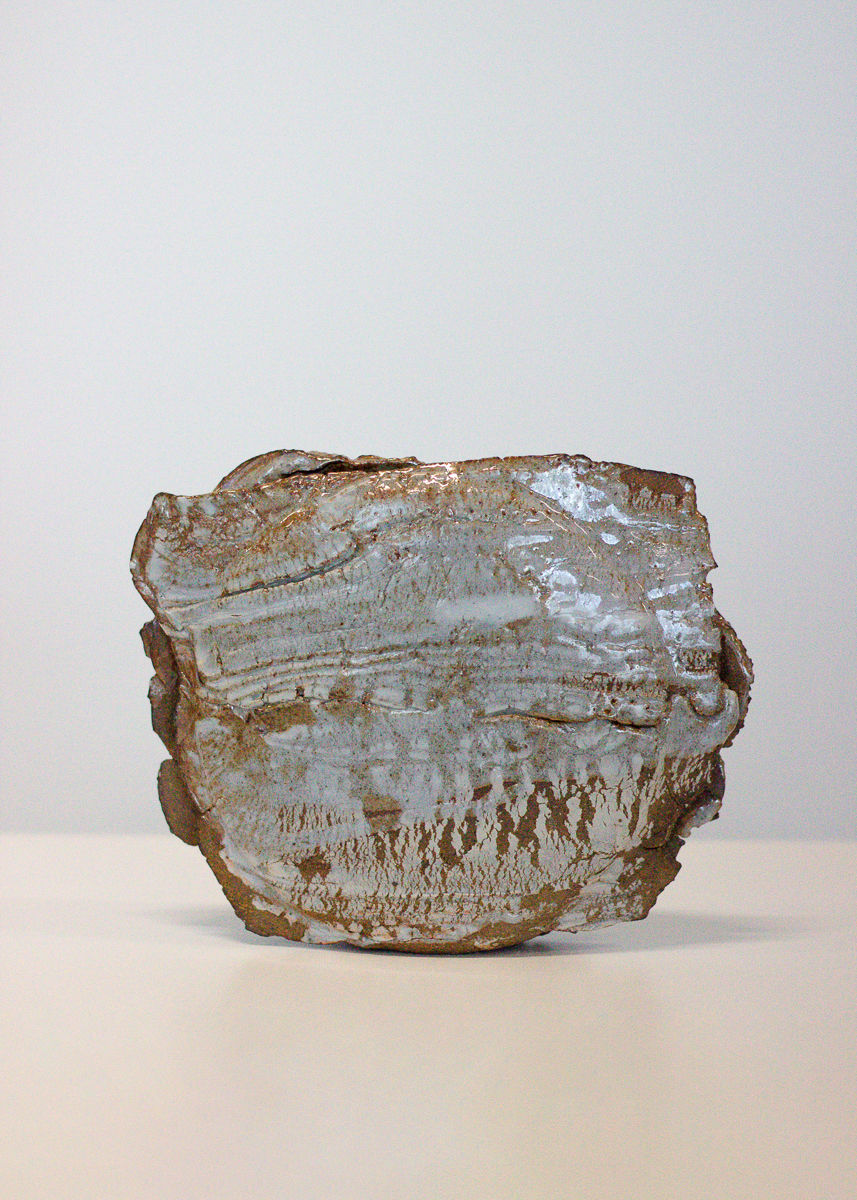
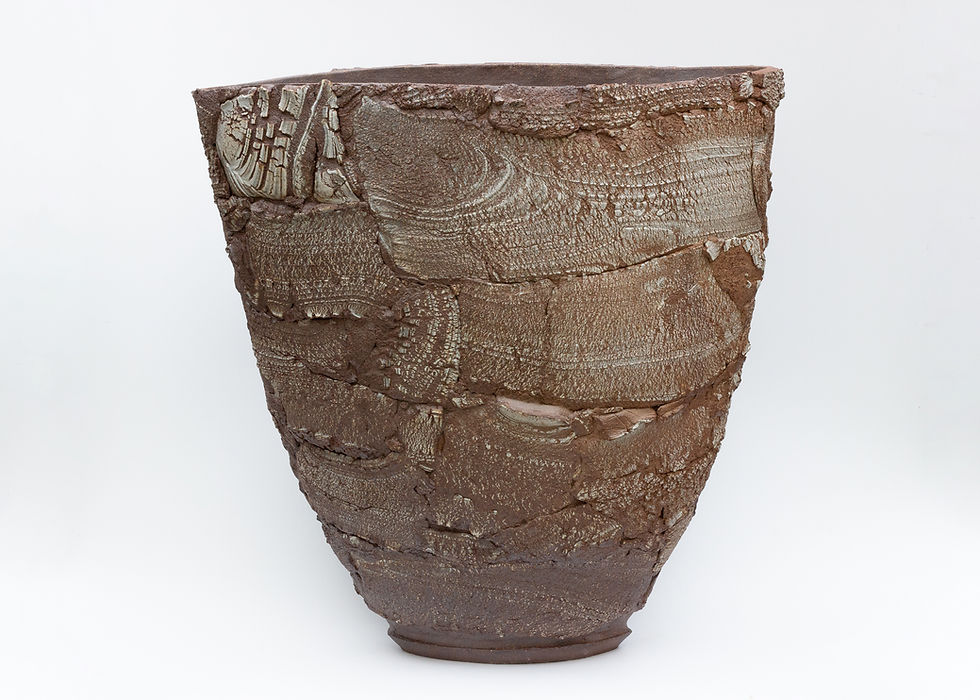
Working intuitively, her making process begins by striking, carving, and faceting blocks or thick slabs of clay. Found objects, such as old tools, driftwood, and fragments of broken pottery, are used to imprint surface traces. These marks are stretched, manipulated, and assembled into hand-built forms that exist between function and abstraction. Through these direct, physical gestures, ideas and forms emerge through action rather than predetermined outcomes.
A careful alchemy of slips, oxides, and glazes is applied, often poured across the surface to record moments of flow, pause, and resistance. Through gas reduction firing, layered surfaces are further transformed, embracing chance and unpredictability. By inviting risk into her work, Heather encourages the true nature of clay and its ability to give something back, navigating the push and pull between time, material and ourselves.
Heather Gibson is a ceramic artist based in London. In 2024, she completed a Master’s degree at the Royal College of Art supported by the Marit Rausing Scholarship for Ceramics & Glass. That same year, she was selected as the inaugural Potter in Residence at County Hall Pottery, leading to her first solo exhibition, ‘Surfacing’ in August 2025.
Gallery Collection
Image Gallery

Artist Q&A
Q&A for the exhibition 'Trace' in June 2023:
Can you talk us through a usual day in your studio?
My studio sits on the top floor of an old sweet factory in North London and houses a vibrant community of potters and ceramic artists. I usually start the day with a good cup of coffee and a quick catch up followed by the most physically demanding task of the day, be it wedging clay or rolling out thick slabs for carving and hand building.
Once the raw materials are prepared, I select my tools. I have a wide variety of found objects in my toolkit. From fragments of broken pottery and driftwood to combs and wires, I use each unique tool to etch and carve, carefully constructing each vessel. I tend to work in series, each piece informing the next, allowing for discoveries to be made along the way. All my ceramics are entirely hand built, then slipped and fired to 1000°C, before being layered with glaze and fired again to stoneware in an electric kiln.
What first drew you to clay?
I originally trained as a Photographer, although I always felt there was something more I was seeking creatively. I first discovered clay whilst working as a studio assistant for a ceramic artist and was immediately drawn to the physical nature of the material. Getting back in touch with working with my hands brought back the fearless, primal nature of creating that I’d been missing. I love that the possibilities with clay feel endless. Photography still very much informs my practice. Using my camera I explore peripheral areas of the city, capturing transitional spaces in the urban landscape. My photographs act as sketches, which I then explore through the tactility of clay.
What’s been the biggest pivotal moment in your practice so far?
This year, I began pursuing ceramics full time. I have always split my time between different jobs, so focusing completely opened lots of new possibilities for me. I recently took part in my first Potfest and later in the year I will be attending the Royal College of Art to undertake a masters in Ceramics and Glass. I am feeling confident in the direction my work is going and am very excited to see where a year of in-depth study will take me.
Is functionality important to your forms?
Exploring functionality in my forms is important to me because it reflects the accessibility that ceramics represents. The shapes I create echo early forms of pottery which were created to serve a utilitarian purpose. By exploring recognisable forms, I hope to uncover our relationships with these objects and how we can explore deeper meanings of the past, place, culture and people.
Your mark making is so intuitive, what are you thinking about as you work? Do you listen to music?
Like many ceramicists, I am especially inspired by Japanese and Korean pottery traditions such as ‘kurinuki’ and ‘buncheong’. There is a semi-performative element to this style of working which fascinates me. I love the act of pouring, brushing or splashing slip and glaze. I enjoy listening to a variety of music to help me find a rhythm in my movements. I try to be unselfconscious. My method unfolds organically, responding to circumstances and evolving with them.
You obviously have a strong relationship from your process with your materials, can you tell us more about the red clay you use?
While working on this collection, I chose to work with a distinctive red sculptural clay body, rich in iron and ideal for carving and capturing impressions. My process starts by getting a feel for the unique characteristics of the clay, building a foundation for the raw form to develop. To add dimension to the sculptural surfaces created, I then layer contrasting white slips and glazes that allow the raw earthy surface underneath to still be seen. I continue to be fascinated by this clays ability to give something back, something beyond control.